
TL;DR
A HEPA air purifier sized to deliver at least 4.8 air changes per hour (ACH) in your bedroom will produce small but measurable improvements in allergy symptoms, according to EPA reviews and multiple clinical trials. Skip ionizers and “medical grade” marketing. Instead, match your room’s cubic footage to a verified CADR number, pick a model with replacement filters you can actually afford, and run it 24/7 with windows closed during allergy season. This guide walks through the sizing math, explains which specs matter for different allergens, and recommends seven purifiers (plus a DIY option) by use case and budget.
At-a-Glance Comparison
| Model | Best For | Approx. Price (April 2026) | CADR (smoke/dust/pollen, cfm) | Key Differentiator | Community Take |
|---|---|---|---|---|---|
| Voltiva labs Home Air Purifier | Budget compact, small rooms | $129.99 | Not published | HEPA + ionizer + aromatherapy tray | Accessible entry point for bedroom use |
| Coway AP-1512HH Mighty | Best overall under $250 | ~$200-$230 | 233/240/247 | Ionizer toggle off, Eco mode | “Great value, just size correctly” (Reddit) |
| Levoit Core 400S | Smart/quiet bedroom | ~$200-$220 | 231/240/259 | Wi-Fi app, auto mode, very quiet sleep | “Quiet + app; light carbon” (Reddit) |
| Winix A231/A230 | Budget small-room cylinder | ~$80-$120 | ~148 (PM1, tested) | PlasmaWave disable, bonded HEPA + carbon | “Value can’t be beat” (Reddit/HouseFresh) |
| Blueair Blue Pure 311i Max | Medium-room all-rounder | ~$240-$260 | Strong (multiple reviews) | Simple UI, smart features | “Balanced performance” (forum consensus) |
| Alen BreatheSmart 45i | AAFA-certified peace of mind | ~$400-$470 | Certified | AAFA “asthma & allergy friendly” | “Quiet/premium; filter DRM complaints” (Reddit) |
| Corsi-Rosenthal Box (DIY) | Big spaces, peak pollen | ~$60-$120 in parts | 600-850 (studies) | Massive CADR per dollar | “Ugly but effective” (community builds) |
Do Air Purifiers Really Help With Allergies?
What the EPA and clinical trials show
The short answer: yes, but with caveats. The EPA’s guide to residential air cleaners notes that portable HEPA units show small but measurable improvements in allergy and asthma symptoms when used continuously, particularly in bedrooms. source Multiple randomized controlled trials support this, finding reductions in particulate matter and symptom relief in both rhinitis and asthma patients using bedroom HEPA filtration. source
The key word is “continuously.” An air purifier for allergies doesn’t work like a pill you take once. It needs to be running all the time in a room that’s actually closed off, processing the air enough times per hour to keep allergen concentrations low. Turn it off, open the windows during a pollen spike, or put a unit rated for 150 square feet in a 500-square-foot open plan, and the benefit drops to nearly nothing.
When a purifier won’t help
Air purifiers are not mold remediation tools. If you have a moisture problem (leaking pipes, poor bathroom ventilation, condensation on windows), no amount of HEPA filtration fixes the source. The CDC and EPA both say to address moisture first. source
They also won’t eliminate dust-mite allergens on their own. The primary allergenic protein from dust mites (Der p 1) lives mostly in reservoirs like bedding, carpets, and upholstered furniture. A HEPA purifier catches what becomes airborne, but you still need regular washing, encasements, and humidity control below 50% relative humidity. source If you’re looking for a compact humidifier to keep indoor humidity in the optimal 40-50% range without overdoing it, the anti-gravity water drop humidifier is a space-saving option for bedrooms.
Size It Right in 60 Seconds: ACH Over Marketing Claims
The 4.8-5 ACH allergy rule and a quick CADR example
Most air purifier boxes list a “recommended room size.” That number is based on AHAM’s standard of 4.8 air changes per hour (ACH), meaning the purifier processes the room’s entire air volume about five times every 60 minutes. source For allergy relief, 4.8 to 5 ACH is the target. Anything less, and you’re not clearing allergens fast enough to matter during peak season.
Here’s the one-minute math. Take a standard 12 x 12 foot bedroom with 8-foot ceilings:
- Room volume = 12 × 12 × 8 = 1,152 cubic feet
- Target ACH = 5
- Required CADR = (1,152 × 5) ÷ 60 = 96 cfm minimum
That’s the floor. In practice, buying one size up means you can run the purifier on a lower (quieter) speed while still hitting allergy-grade air exchanges. Practitioners on Reddit consistently emphasize this point. As one user in r/AirPurifiers put it, “4.8-5 ACH is a better target than ‘max square footage’ claims.” source
For rooms with tall ceilings, open floor plans, or heavy allergen sources, the EPA recommends selecting a larger CADR to compensate. source WIRED’s 2026 guide offers a useful heuristic: divide the marketed “max coverage” by five to get a realistic allergy-grade room size. source
Specs That Matter for Allergy Relief
True HEPA vs “medical grade”
A true HEPA filter captures at least 99.97% of particles at 0.3 micrometers, per the US Department of Energy definition. The European equivalent, H13 under EN 1822, captures 99.95% at the most penetrating particle size (MPPS). source
“Medical grade” applied to consumer air purifiers is a marketing term with no regulated definition. If a listing says “medical grade HEPA” but doesn’t reference an actual standard (H13, H14), treat the claim with skepticism.
CADR and ENERGY STAR/AHAM verification
CADR (Clean Air Delivery Rate) is the single most useful spec for comparing purifiers for allergy relief. It measures actual clean air output in cubic feet per minute across three particle types: smoke, dust, and pollen. Look for AHAM-verified CADR numbers or ENERGY STAR product listings, which require third-party testing. source
Different allergens respond to different aspects of that spec:
- Pollen (typically 20-50 µm) is large enough that virtually any HEPA catches it. The bottleneck is airflow, not filtration efficiency. Higher CADR means faster pollen removal. source
- Pet dander (0.1-25 µm) is much finer and stickier. You need true HEPA plus a good prefilter to keep the main filter from clogging prematurely, which increases noise as airflow resistance grows. source
- Odors and VOCs aren’t particles at all. For these, the EPA says to look for substantial activated carbon mass (not a thin carbon sheet). source
Ionizers and ozone: CARB cautions
Many purifiers include an ionizer toggle. The EPA warns that ionizers can produce ozone, a lung irritant, and are not recommended for occupied spaces without careful consideration. source In California, portable air cleaners must be CARB-certified to emit no more than 0.050 ppm ozone. source
The safest approach for allergy sufferers: choose HEPA-only mode. If your purifier has an ionizer, make sure it can be permanently disabled, and check CARB’s certified product list if you’re in California.
The 7 Best Air Purifiers for Allergies in 2026 (by Use Case)
1. Voltiva labs Home Air Purifier with HEPA Filter
Best for: Entry-level HEPA filtration in a small, closed bedroom or nursery at an accessible price.
Price: $129.99 (US, April 2026)
Key features:
- HEPA filtration for particle capture
- Built-in ionizer and aromatherapy tray
- Compact footprint designed for bedrooms, offices, and nurseries
Honest trade-offs:
- No published CADR, room-size rating, or AHAM/ENERGY STAR/AAFA certification on the product page, so you can’t ACH-size it with precision from the listing alone
- Includes ionization and aromatherapy, both of which can be irritants for sensitive users; the EPA and CARB recommend caution with ionizer technologies source
- Replacement filter pricing and availability not listed on the product page
Who should consider it: If you want to try HEPA filtration in a small, closed room (think a 100-150 sq ft bedroom) without committing $200+, this is a reasonable starting point. Run it continuously with doors and windows closed for the best results, per EPA guidance. For allergy control specifically, consider using the HEPA mode and skipping the ionizer and aromatherapy functions.
Tip: Place the unit near your bed with clear airflow around it. The EPA recommends running purifiers 24/7 in rooms where you spend the most time. source
2. Coway Airmega AP-1512HH Mighty
Best for: Best overall allergy air purifier under $250 with verified performance and years of community trust.
Price: ~$200-$230 (April 2026 retail)
Key features:
- ENERGY STAR verified CADR: approximately 233 smoke / 240 dust / 247 pollen cfm source
- Suggested room size ~360 sq ft at AHAM’s 4.8 ACH
- HEPA + carbon sheet + washable prefilter
- Ionizer can be toggled off
- Eco mode that cuts power when air quality is stable
Honest trade-offs:
- Not a “smart” purifier (no app, no Wi-Fi)
- Air quality indicator ring uses a non-standard color scheme that confuses some users
- Glossy finish attracts dust and pet hair
Community perspective: The Coway Mighty is something of a Reddit darling in r/AirPurifiers, recommended year after year. But practitioners on the forum note a common mistake: people buy it for open-plan spaces where it can’t deliver enough ACH. One user summarized it well: “Great value, but don’t oversize expectations for an open plan.” source
Hidden costs: Annual filter replacement runs moderate; third-party filters exist but quality varies according to community consensus. Budget roughly $40-$60 per year for OEM replacements.
3. Levoit Core 400S
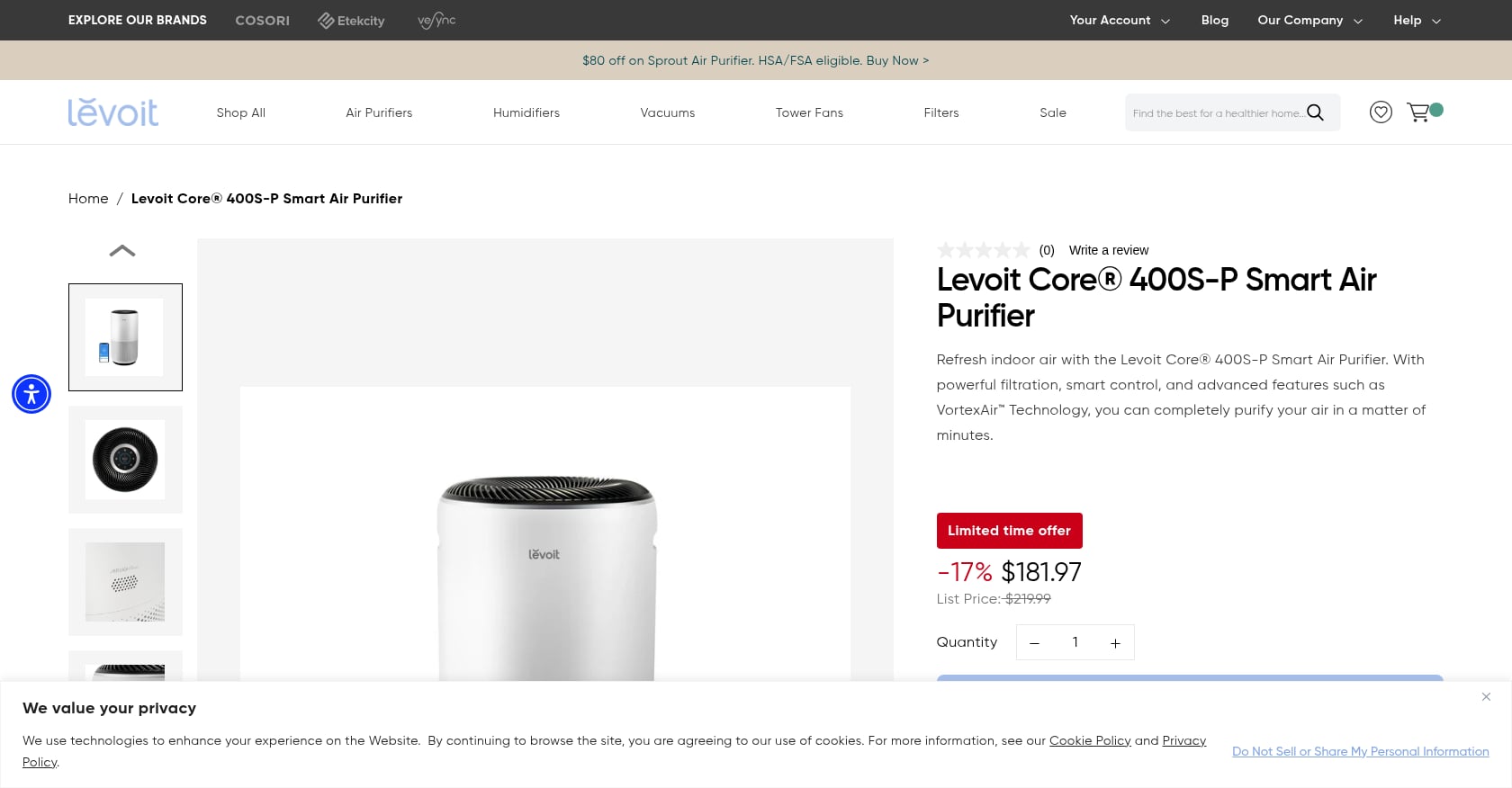
Best for: Quiet bedroom operation with smart automations for pollen season.
Price: ~$200-$220 (frequently discounted)
Key features:
- ENERGY STAR CADR: 231 smoke / 240 dust / 259 pollen cfm source
- Wi-Fi connected with app control and auto mode
- Very quiet sleep mode
- No ionizer
Honest trade-offs:
- Thinner carbon layer means weak performance on strong odors (fine for particle allergens, not great if you also need VOC/cooking odor control)
- Filter replacement needed roughly every 6-12 months depending on environment; costs add up
- Auto mode sensors can be overly sensitive, toggling fan speeds frequently
Community perspective: Users on Reddit praise the quiet operation and useful app. Several note the convenience of auto mode during pollen spikes, while others caution: “Carbon is lighter, so don’t expect miracles for odors.” source Tom’s Guide testing confirmed the filter cadence variability, noting environment matters more than the timer. source
4. Winix A231/A230
Best for: Budget-friendly allergy air purifier for dorms, nurseries, and small bedrooms under 220 sq ft.
Price: ~$80-$120 (often on sale)
Key features:
- HouseFresh tested PM1 CADR at approximately 148 cfm, delivering 5 ACH up to ~222 sq ft source
- Bonded HEPA + carbon filter (combined unit)
- PlasmaWave ionizer can be disabled
Honest trade-offs:
- Gets loud at maximum fan speed
- No auto sleep mode via light sensor
- PlasmaWave re-enables itself after power loss, so you need to manually turn it off again each time
Community perspective: Testers at HouseFresh and users on Reddit call it a value standout for small rooms. The consensus is that the performance-per-dollar ratio is hard to beat if you can tolerate the noise at higher settings. OEM filters run around $50/year, with cheaper generics available.
5. Blueair Blue Pure 311i Max
Best for: Medium bedrooms and living rooms (300-400 sq ft) needing strong airflow with minimal fuss.
Price: ~$240-$260 (April 2026)
Key features:
- Strong CADR performance across multiple expert reviews source
- Simple, intuitive controls
- Smart features including app connectivity
- Fabric pre-filter comes in multiple colors
Honest trade-offs:
- Uses HEPASilent technology, which combines mechanical filtration with electrostatic charging; this is technically an ionization-adjacent approach, so check CARB certification status if you’re in California (Blueair sells CARB-certified models) source
- Occasional stock issues reported in retail threads
- Fabric pre-filter needs regular washing
Community perspective: Frequently recommended in big-box retail discussions on Reddit, with users describing it as a balanced, fuss-free performer. source
6. Alen BreatheSmart 45i
Best for: Buyers who want independent AAFA certification and are willing to pay a premium for it.
Price: ~$400-$470 (April 2026)
Key features:
- Carries AAFA/ASL “asthma & allergy friendly” certification, meaning independent testing against allergen reduction and byproduct safety standards source
- Quiet operation
- Multiple filter options (Fresh, Odor, Pet)
- Lifetime warranty (with filter subscription, per manufacturer terms)
Honest trade-offs:
- Significantly more expensive per CADR point than the Coway or Levoit
- Uses RFID/DRM on filters, which blocks third-party replacements; a sore point in the community
- Mixed anecdotes on odor handling despite the “Odor” filter option
Community perspective: Users on r/AirPurifiers have flagged the filter DRM issue: “PSA: Alen air purifiers use RFID/DRM to block the use of third-party filters.” source The Rabbit Air A3 is another AAFA-certified alternative at a higher price point with a similar quiet, premium profile.
7. Corsi-Rosenthal Box (DIY)
Best for: Large spaces, garage workshops, or temporary high-pollen/wildfire events on a tight budget.
Price: ~$60-$120 in parts (box fan + four MERV-13 filters + tape/cardboard)
Key features:
- Performance studies report CADR of 600-850 cfm depending on fan speed and build quality, enough to hit 5+ ACH in very large rooms source
- Uses widely available 20" box fans and standard furnace filters
- No proprietary replacement parts
Honest trade-offs:
- Loud, especially at higher fan speeds
- Large and not attractive (a literal box of filters)
- Filter edges must be sealed carefully with tape or gasket to prevent air bypass
- No sensors, no app, no auto mode
Community perspective: Originally popularized during COVID for classroom ventilation, the Corsi-Rosenthal box has found a second life among allergy sufferers who need massive airflow in open spaces. It’s the most CADR per dollar you can get, by a wide margin. If aesthetics and noise are secondary concerns (garages, workshops, covered porches during pollen season), this is the practical choice.
Setup Tips That Make the Difference
Placement, runtime, windows, and housekeeping
Buying the right air purifier for allergies is only half the equation. How you use it matters just as much.
Run it 24/7. The EPA is clear: more runtime equals more filtration. Turning it off at night or while you’re at work gives allergens time to accumulate. If you’re going to prioritize one room, make it the bedroom, so you wake up clearer. source
Place it where it “sees” the air. Position the unit near your bed, between the pollutant source (window, door, pet bed) and where you breathe. Don’t shove it in a corner behind furniture where the intake and exhaust are blocked.
Keep windows closed during high pollen counts. This sounds obvious, but it’s the most common mistake. Running a purifier with windows open during a pollen spike is like mopping with the faucet running.
Vacuum and launder regularly. Settled allergens on floors, bedding, and upholstery get re-suspended every time someone walks through the room or flops on the couch. A HEPA purifier only catches what’s airborne. Washing bedding weekly in hot water and vacuuming with a HEPA-equipped vacuum complements air filtration significantly. For thorough dusting of vents, high shelves, and forgotten corners, a high-power LED flashlight helps you spot dust accumulation that’s otherwise invisible. Similarly, LED headlamp glasses free up your hands while cleaning behind furniture or inside closets where allergens settle.
Don’t use purifiers to “treat” mold. Fix moisture sources first. A purifier may catch some mold spores, but as long as the colony is growing, you’re losing that race.
Complement with MERV-13 HVAC and humidity control
The EPA recommends upgrading central HVAC filters to at least MERV-13, if your system can handle the increased airflow resistance. Running the HVAC fan periodically (even without heating or cooling) adds equivalent ACH across the whole house. source
A Wi-Fi smart thermostat can schedule your HVAC fan to circulate air during peak pollen hours, effectively giving you whole-home filtration on top of your bedroom purifier. This one-two approach (portable HEPA where you sleep, MERV-13 on the central system) is the strategy the EPA recommends.
Humidity control matters too. Keeping indoor relative humidity between 40% and 50% discourages dust mite reproduction without drying out your sinuses. Too humid, and mold and mites thrive. Too dry, and your mucous membranes suffer, making allergy symptoms feel worse.
Frequently Asked Questions
How many air purifiers do I need for an apartment?
One per room where you spend significant time. Most people start with one in the bedroom (where you spend 7-9 hours) and add a second in the living room if budget allows. The key is matching each unit’s CADR to the room’s cubic footage at 4.8-5 ACH. A single purifier in a hallway won’t clean an entire apartment.
Do I need an H13 filter, or is regular HEPA enough?
For allergies, a standard true HEPA filter (99.97% at 0.3 µm) is more than sufficient. H13 under the European EN 1822 standard captures 99.95% at the most penetrating particle size. source The difference is negligible for residential allergy relief. “Medical grade” labels on consumer purifiers are marketing, not a regulated standard.
What ACH should I target if I have pets and pollen allergies?
Aim for 5 ACH in the rooms where your pets spend time. Pet dander particles (0.1-25 µm) are finer and stickier than pollen grains, so you need sustained airflow to keep concentrations low. A strong prefilter also helps prevent pet hair from clogging the HEPA element prematurely, which would increase noise and reduce performance over time.
Are ionizers safe for allergy sufferers?
The EPA and California’s CARB both urge caution. Ionizers can produce ozone as a byproduct, which is a lung irritant that may worsen respiratory symptoms. source If your purifier includes one, disable it and run in HEPA-only mode. If you live in California, confirm the device is CARB-certified before purchasing.
How often should I replace filters?
Most HEPA filters need replacement every 6-12 months, but this varies by environment. Homes with pets, high pollen exposure, or nearby construction will clog filters faster. Some models have filter-life indicators, though community experience suggests these aren’t always accurate. Check the filter visually every few months and budget $40-$80 per year for replacements on most mid-range units.
Can a Corsi-Rosenthal box really replace a commercial air purifier?
For raw CADR, yes. Studies measured 600-850 cfm from well-built boxes, outperforming commercial units costing $300+. source The trade-offs are noise, size, and aesthetics. They’re excellent for garages, living rooms during wildfire smoke events, or any situation where you need massive filtration capacity temporarily. For a bedroom, most people prefer the quieter, more compact form factor of a commercial unit.
Is AAFA certification worth paying extra for?
AAFA certification from the Asthma and Allergy Foundation of America means the purifier passed independent testing for allergen reduction and byproduct safety. source It’s a meaningful credential, not just a marketing badge. Whether it’s worth the $200+ premium over models like the Coway Mighty depends on how much you value that independent verification versus trusting ENERGY STAR CADR numbers and community feedback.
Where should I start if I just want something simple for my bedroom?
If you’re new to air purifiers for allergies and want an affordable starting point for a small bedroom, the Voltiva labs Home Air Purifier with HEPA Filter at $129.99 is a compact option. Use it in HEPA-only mode with the door closed for best results. For larger rooms or verified CADR data, step up to the Coway Mighty or Levoit Core 400S.